
GDPR Training for Staff: Role-Based Scenarios and a Training Record
Effective staff privacy training asks people to recognise a decision in their own workflow, choose a safe action and know when to escalate. These six scenarios provide discussion prompts and answer keys; attendance alone does not show that controls work.
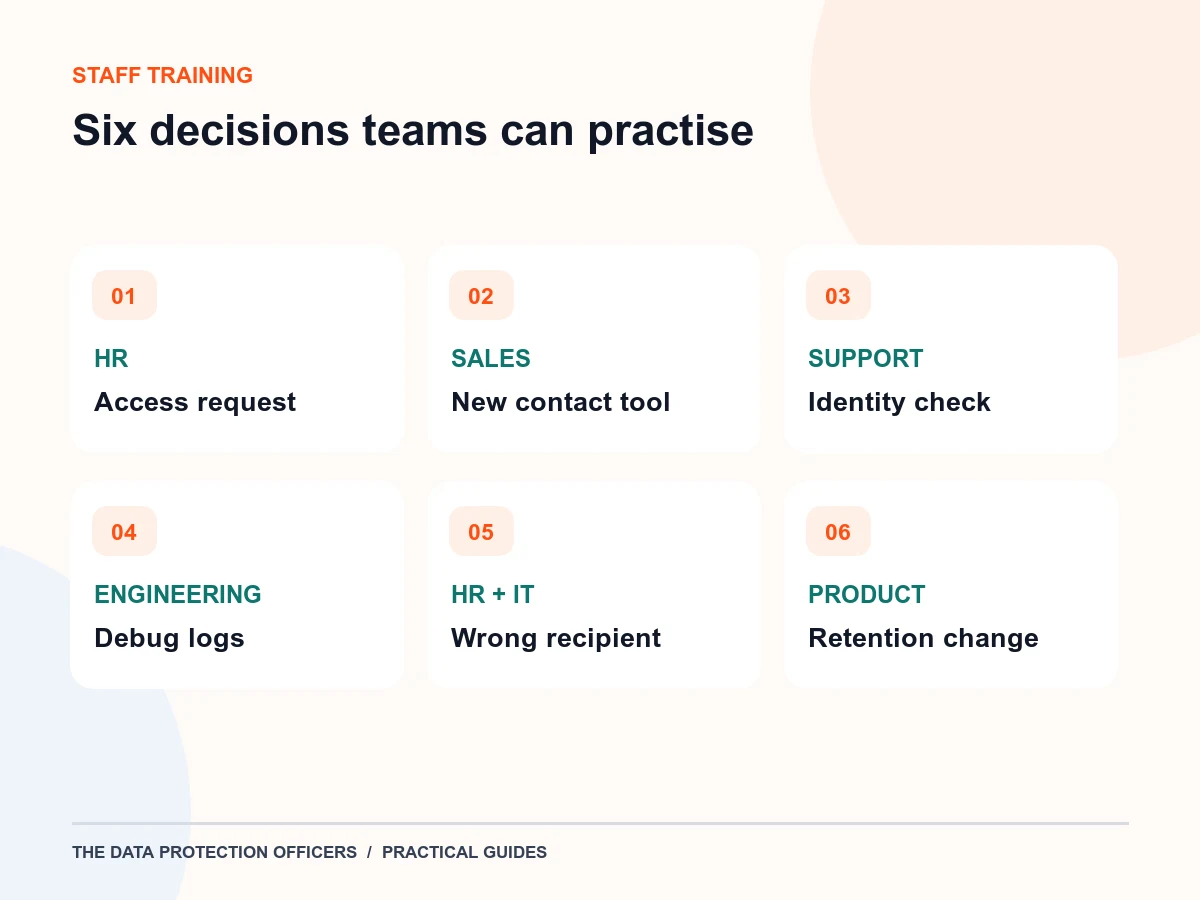
Teach the decision each role actually faces
Start with the data and systems each role can touch. HR needs to recognise sensitive personnel records and access requests; sales needs clear rules for contact lists; support needs identity and rights-request routing; engineering needs access, retention and supplier-change escalation. Use the organisation's own approved procedures when practising.
The following fictional situations are training prompts, not legal determinations. The answer key describes a safe first action and why the team should escalate where facts or legal grounds are uncertain.
Six mini scenarios with answer keys
1. HR receives a message from a former employee asking for every note held about them. Answer: route it as a possible subject access request immediately, preserve relevant records and log the receipt date. Do not insist on a form.
2. A salesperson wants to upload a customer contact export into a new prospecting tool. Answer: pause the upload, check the approved purpose, supplier terms, access and transfer route, then seek the named owner’s decision.
3. Support is asked to change an account email after a caller provides only a company name. Answer: use the approved identity and account-change procedure before disclosure or change; escalate uncertainty.
4. An engineer discovers that a debug log contains full user messages. Answer: restrict access, preserve evidence, notify the incident owner and assess exposure; do not silently delete the trail.
5. HR sends a spreadsheet containing salary data to the wrong internal distribution list. Answer: report promptly through the incident route, identify recipients and contain access. Whether regulatory notice is needed requires an assessed decision.
6. A product manager wants to retain deleted-account data indefinitely “in case analytics needs it.” Answer: check the stated purpose and retention schedule, identify a narrower need and obtain a documented decision before changing retention.
Keep a training and follow-up record
Record the role, module version, completion date, scenario answer, follow-up action and owner. Do not record unnecessary personal detail in the training log. An incorrect answer is a cue to improve the procedure or repeat training, not merely to issue a certificate.
| Field | Illustrative entry |
|---|---|
| Audience / version | Support team / rights and incident scenarios v2 |
| Learning check | 4 of 5 decisions explained correctly |
| Follow-up | Retest account-change verification in next team exercise |
| Review trigger | New support tool, incident pattern or policy change |
Refresh after a workflow changes
Revisit scenarios when a new system, supplier, role, incident or legal change alters the choice staff should make. Test the escalation channel with a realistic example and update instructions if the right owner cannot be reached.
Frequently asked questions
Is a training attendance certificate proof of GDPR compliance?
No. Attendance is one piece of evidence. Check understanding, role-specific decisions, escalation and whether the actual controls work.
Should everyone receive identical training?
A common baseline is useful, but high-impact roles should practise the decisions and systems they use.
Keep researching
Related resources
A practical next step
Make the next privacy decision clearer
Bring your organisation, processing, jurisdictions, current documents, internal owners, and deadline. We can help identify the right scope before an appointment or wider workstream begins.
This guide provides general information, not legal advice or a conclusion that a particular obligation applies. Confirm the legal scope and practical next steps against your organisation's facts.
Sources: ICO: A guide to subject access, ICO: Personal data breaches, EDPB: Be compliant